

What are the Best Practices for Source Water Protection?
Do you drink water from a private well or intake? Then this section is for you. While Ontario’s Drinking Water Source Protection Program is generally focused on protecting municipal water sources, over 50% of the population within the Trent Conservation Coalition Source Protection Region is on private wells or drawing water from lakes, including most cottagers. A recent initiative launched in 2022 in conjuction with the Ministry of the Environment, Conservation and Parks is intended to extend the Best Practices learned from the Source Protection Program and regional Source Protection Plans, to owners of private systems, to increase local knowledge about the threats to their water sources, and what steps they can all take to protect them.
For a more indepth and engaging look at the Best Practices, we’d recommend the following storyboard walk-through of the guidance here, with helpful figures, images and quizes to best ensure your understanding. It contains information that can help cottagers, homeowners, small villages and rural schools that don’t have the luxury of safe municipal water. Click here to view on a separate page.
In conjunction with this effort launched by the Ministry of the Environment, Conservation and Parks, the Trent Conservation Coalition Source Protection aims to recognize the vulnerabilities of private wells, surface water intakes, and non-municipal drinking water systems, and seek to educate, provide resources and raise awareness of the threats to those drinking water sources and ways to mitigate the threats.
Municipal vs Private Systems
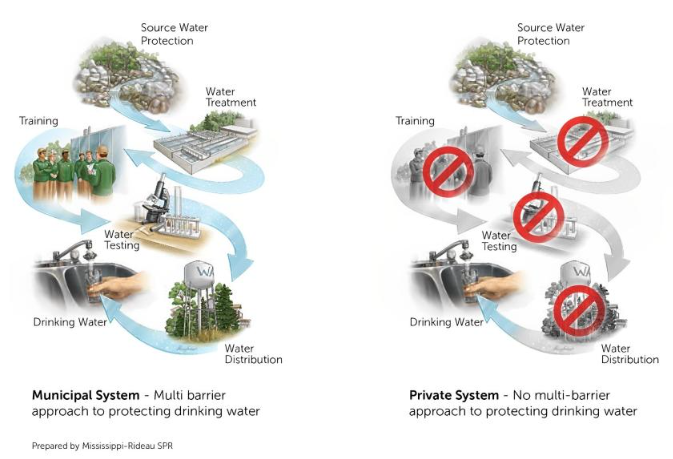
The success of the Municipal Drinking Water Source Protection Program is built on the multi-barrier approach. This diagram illustrates that approach to protecting municipal drinking water systems. As you can see, municipal systems have more resources compared to private system owners. When you own a non-municipal drinking water system, it is important to operate it responsibly and test it regularly. It’s up to you to fill in those gaps and create your own multi-barrier approach.
The Ontario well records map is also a useful resource for seeing where wells are located near you.
Water Testing
The best thing you can do to ensure your private drinking water system is providing safe drinking water is to regularly test your water.
Public Health Ontario – Water Testing Portal
This online Water Testing Portal provides a streamlined way to electronically submit your requisition and access your online report. Simply collect your sample, submit your information online, drop off your sample and access your online report.
Drinking Water Wise Webinar Series
The Trent Conservation Coalition, Cataraqui, Rideau Valley, and Quinte Conservation have partnered to provide the Drinking Water Wise Webinar series. This is a FREE Microsoft Teams webinar series to help educate landowners and realtors on the importance of drinking water protection through monitoring and maintaining household systems. Each webinar will have a presentation about the Best Practices for Source Water Protection and a presentation from an expert in the field. All webinars will be recorded and available to view on Youtube afterwards. The webinar topics and schedule are as follows:
| Harmful Algal Blooms | https://youtu.be/Dkk2uDF2uFg?si=q9IN-IfbiS9sGKS- |
| Well Care 101 | https://youtube.com/watch?v=zIF4txB83tc&list=PLXMeFEnFdlaU2qMr3UUmIh7bYy1iCAyY6 |
| Septic Care 101 | https://youtu.be/_vP3_HWXkg0 |
| Realty and Rural Drinking Water | https://youtu.be/2KfOcKGP7jc |
| Drinking Water Testing & Treatment | https://www.youtube.com/watch?v=YTn7WLLhi8o |
| Groundwater 101 | https://www.youtube.com/watch?v=E0bcV5qtgu4 |
| Harmful Algal Blooms: Science and Solutions | https://www.youtube.com/watch?v=jhjHpb7FAlA |
| Impact of Climate Change on Boil Water Advisories and Drinking Water Safety | https://www.youtube.com/watch?v=jCfkgpkfWjI |
| Well Maintenance and Safety | https://www.youtube.com/watch?v=pwL4r_v0B80 |
| History of Source Water Protection | https://www.youtube.com/watch?v=GAbKhak1gdk |
| Cisterns 101 | https://youtu.be/unvTNpFdWiU?si=xRXULBoy9ALF35aM |
| Septic Care 102 | https://www.youtube.com/watch?v=D6BT636Hrh0 |
| Karst Geology and Source Water Protection | https://youtu.be/V23hV990JTU |
| Indigenous Water Teachings | https://www.youtube.com/watch?v=2YYERHiPz_U&t=3s |
| The State of Drinking Water in Ontario | https://www.youtube.com/watch?v=FqlkMpq11Xk |
Stay tuned for more webinar announcements into 2025. You can visit our registration page for more information about each Drinking Water Wise Webinar, or contact any of the staff involved:
- Trent Bos
- trent.bos [AT] ltc.on.ca
- Trent Conservation Coalition Source Water Protection
- Kelsey Lablanc
- klablanc[AT] crca.ca
- Cataraqui Conservation Source Water Protection
- Natasha Mathieu
- nmathieu [AT] quinteconservation.ca
- Quinte Conservation Source Water Protection
- Marika Livingston
- marika.livingston [AT] mrsourcewater.ca
- Mississippi-Rideau Source Water Protection
Flooding and Private Drinking Water
What are the risks?
Flooding can affect water quality, and this is a particular concern for rural residents in Ontario on private drinking water systems. Be aware that flooding may cause contamination of private water sources, such as wells.
What should I do?
- If you use a private well for your water supply, contact your local public health unit for water quality information and to have your water tested by Public Health Ontario. There are eleven Public Health Ontario laboratory sites that test private drinking water supplies for indicators of bacterial contamination. In addition to bacterial contaminants, flood waters may carry chemical and other contaminants in to your well. Should you wish to test for chemical contaminants, a list of accredited laboratories offering chemical testing in Ontario drinking water can be found at: https://www.ontario.ca/document/list-licensed-laboratories.
- In the event that your water is contaminated, or you suspect contamination because of heavy rainfall or flooding, consider using bottled water or a municipal supply, if available. Do not use contaminated water for drinking, food preparation, or for brushing your teeth. Private well water supplies are vulnerable to contamination events at any time and should be tested frequently.
IMPORTANT: Fuel and other chemical releases and spills are common during flood events. If your water smells like fuel or has a chemical odour or if you live in an area where the potential for a release of fuels, pesticides, or other hazardous chemicals is high, contact your local health unit for specific advice. Until you know the water is safe, use bottled water or some other safe supply of water.
Flooding and a private sewage system
If your property is at risk of a flood, or flooded, consider the effect on your private sewage system. A flooded sewage system will not function properly and can cause problems such as:
- sewage backup in your home, and;
- contamination of your water supply.
In the event of a flood, contact your local public health unit for guidance regarding how to manage your private sewage system during the flood period.
For more information, please view this PDF from the HKPR District Health Unit.